I am installing gas hot water b/b heat in an addition. Two story 1440 total sq. foot in N.J. second floor on different zone. I need to get heat into a small first floor foyer with limited wall space, 20 or so inches at the max. Foyer opens from exterior side door, open door into kitchen and other door into unheated stairway leading to basement. Heat calc. calls for 5 feet of true baseboard however that may include heating stairway, of which I will not. I am interested to know who makes a wall mounted, baseboard type (fins and guts) heat exchanger . Not too concerned about height. To be installed in loop, 3/4 inch pex, with rest of floor which includes large living room and kitchen. Really cant fit a kickboard type anywhere but in kitchen.
↧
Wall mounted hydronic heat exchanger
↧
Boiler pressure more than 20 psi
I just checked the pressure of the boiler and I see that it exceeds 20psi, it is somewhere between 20 and 25 (not easy to see from an angle), I am wondering if this is normal;
My boiler is a gaz boiler heating water and it indicates 50psi Max;
Is it ok to have such high pressure during Cold weather? how can I reduce it if I have to? I am looking over the internet but nothing clear found.
Thank you,
My boiler is a gaz boiler heating water and it indicates 50psi Max;
Is it ok to have such high pressure during Cold weather? how can I reduce it if I have to? I am looking over the internet but nothing clear found.
Thank you,
↧
↧
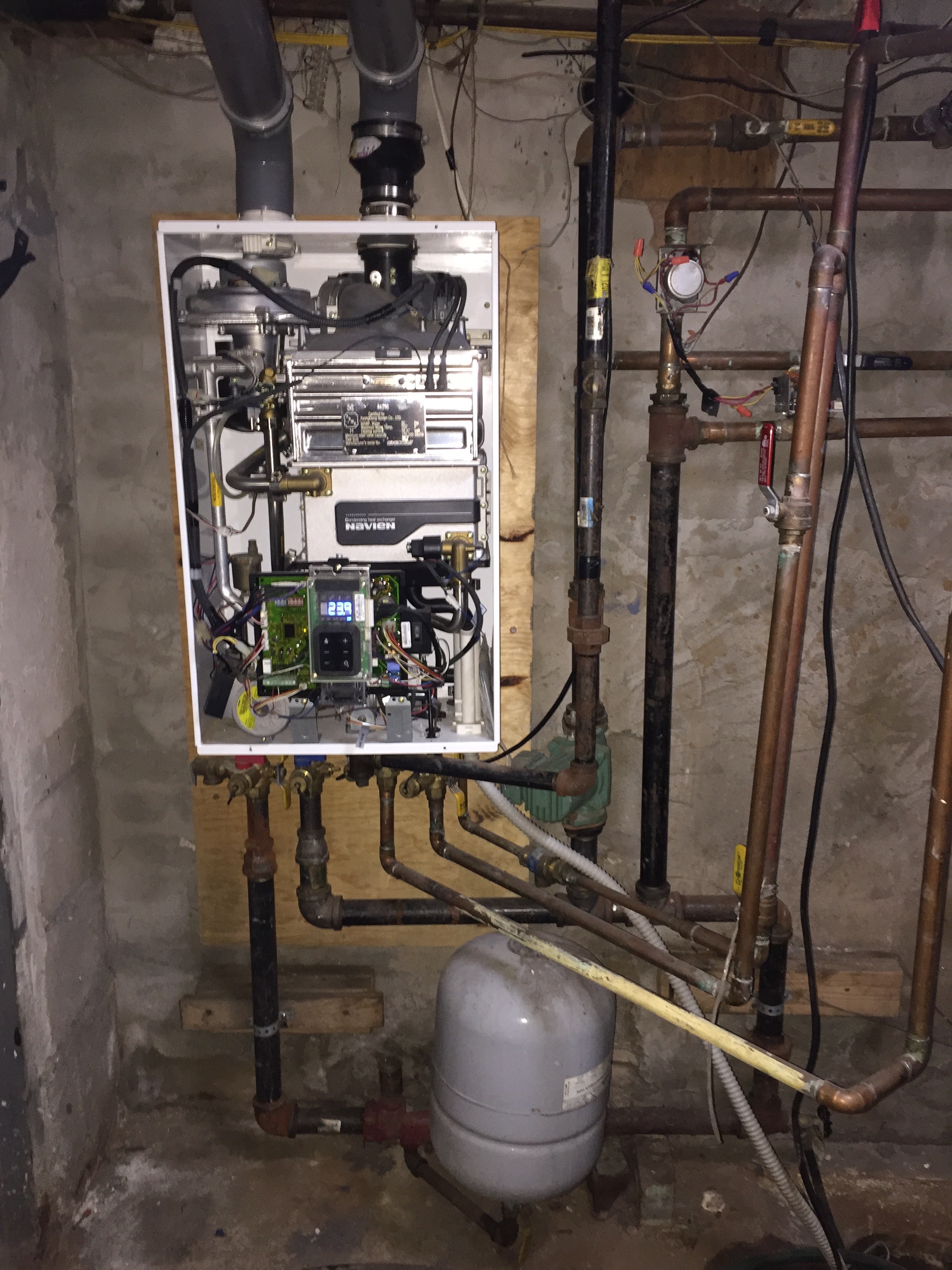
Navien NCB 240 flame loss (error 12)
Hi all,
A couple times a day, and especially every early morning, I get Error 012 (flame loss) at my Navien NCB 240. I have to reset the boiler to make it work again. I have called the installer multiple times but the problem persists. Here is what I have done so far. All with installer and recommendations of Navien support hotline:
- usual maintenance with cleaning filters etc.
- replacement of ignition rod
- redid my entire chimney with brand new polypropylene exhaust and fresh air intake
The boiler was manufactured in 2013 and installed in 2014. It used to run without problems for a while and started to cause problems the last few months, although nothing was changed.
I hope to find someone who has some new ideas or who heard of a similar problem?
Thanks, I am at the point of desperation and am thinking of having to replace this brand new boiler.
![]()
A couple times a day, and especially every early morning, I get Error 012 (flame loss) at my Navien NCB 240. I have to reset the boiler to make it work again. I have called the installer multiple times but the problem persists. Here is what I have done so far. All with installer and recommendations of Navien support hotline:
- usual maintenance with cleaning filters etc.
- replacement of ignition rod
- redid my entire chimney with brand new polypropylene exhaust and fresh air intake
The boiler was manufactured in 2013 and installed in 2014. It used to run without problems for a while and started to cause problems the last few months, although nothing was changed.
I hope to find someone who has some new ideas or who heard of a similar problem?
Thanks, I am at the point of desperation and am thinking of having to replace this brand new boiler.
↧
Is zoning worth it?
I am switching over my oil fired hot water boiler to propane come spring. Current set up is 2 zones; one thermostat is serving 24 cast iron rads on three floors. the other zone is the boiler running pipes to an air handler and pushing out forced air in kitchen/breakfast room.
The rads break out to 9 on first floor, 11 on second, 4 on third. I'm considering putting the first floor on its own zone and the 2nd/3rd floor on its own zone with a thermostat on 2nd flr.
I've had some contractors look at it and it is possible. They would need to run a new pipe off the boiler and tap into the 9 rads. They suggested just doing the supply side and leaving the return pipes on the same return. all the pipes are accessible in open basement ceiling but I'm sure it's still a fair amount of labor to untie these and pipe the new main.
It will all be determined by the estimate $$, but is it wise to do this for the long haul? Meaning, can you expect a fair amount of fuel savings by separating the floors into zones?
The other annoyance is we have a wood burning fireplace in the room where the thermostat is located. The living room heats up quite a bit and then the rest of the house gets cold.
The rads break out to 9 on first floor, 11 on second, 4 on third. I'm considering putting the first floor on its own zone and the 2nd/3rd floor on its own zone with a thermostat on 2nd flr.
I've had some contractors look at it and it is possible. They would need to run a new pipe off the boiler and tap into the 9 rads. They suggested just doing the supply side and leaving the return pipes on the same return. all the pipes are accessible in open basement ceiling but I'm sure it's still a fair amount of labor to untie these and pipe the new main.
It will all be determined by the estimate $$, but is it wise to do this for the long haul? Meaning, can you expect a fair amount of fuel savings by separating the floors into zones?
The other annoyance is we have a wood burning fireplace in the room where the thermostat is located. The living room heats up quite a bit and then the rest of the house gets cold.
↧
Oil burner
Anyone know how this control resets. Honeywell R7997 B 1021 My friend say the green light is blinking and has been all day. Supposed to wait 60 sec and retry. Dosen't say haw many retry's
↧
↧
Trane Invisible Radiator - repair

My house was built in 1935 and contains invisible or concealed radiators in all rooms. Several of the radiators do not heat. Is it possible to repair this type of radiator (I believe I have Trane Invisible Radiators - based on the literature posted on this website) without taking out the wall? All contractors that have looked at these radiators believe the only way to "repair" them is to take apart the wall and "have a look around"
Does anyone have experience with this type of radiator?
Please note, I am a homeowner (not a contractor nor a successful DIYr)
↧
Signal lost between Argo and Aquastat Relay
I did just replace the Aquastat for an issue related to the joint crack. Now when there's a signal sent to Aquastat relay, it clicks and when the temp is beyond the limit (180F) it stops. this is good.
But I have one intermittent issue of the signal that is lost between Argo Control and Aquastat, let me explain:
I have two zones, with two circulators, the circulators are controlled by Argo Control box not but the Aquastat (attached image ); the Aquastat only controls the temp limit of the water (to shut the boiler).
What happens is that the signal is lost somewhere between the thermostat and the aquastat: maybe the Argo has an issue, or may be just there is an issue in cabling because the Argo control starts well the Circulators.
In summary:
- Zone-1: is for the hot water to use in the house.
- Zone-2: is for the heating; there are 3 zones valves but they all share the same zone.2 in the Argo control, if one of zone valves starts (once the temp for one thermostat in house reaches the minimum) , the signal is sent to the boiler via Aquastat.
What happens is this: the thermostat reaches the minimum temp, sends a signal to the zone valve that turns and send signal to Argo Control, which than starts the circulators and also send the signal to the Aquastat relay, if temp is less than 180F, the Aquastat sends signal to the gas valve for the boiler to starts.
the signal is lost somewhere between Argo and the Aquastat in an intermittent way: sometimes it works sometimes not....
![]()
But I have one intermittent issue of the signal that is lost between Argo Control and Aquastat, let me explain:
I have two zones, with two circulators, the circulators are controlled by Argo Control box not but the Aquastat (attached image ); the Aquastat only controls the temp limit of the water (to shut the boiler).
What happens is that the signal is lost somewhere between the thermostat and the aquastat: maybe the Argo has an issue, or may be just there is an issue in cabling because the Argo control starts well the Circulators.
In summary:
- Zone-1: is for the hot water to use in the house.
- Zone-2: is for the heating; there are 3 zones valves but they all share the same zone.2 in the Argo control, if one of zone valves starts (once the temp for one thermostat in house reaches the minimum) , the signal is sent to the boiler via Aquastat.
What happens is this: the thermostat reaches the minimum temp, sends a signal to the zone valve that turns and send signal to Argo Control, which than starts the circulators and also send the signal to the Aquastat relay, if temp is less than 180F, the Aquastat sends signal to the gas valve for the boiler to starts.
the signal is lost somewhere between Argo and the Aquastat in an intermittent way: sometimes it works sometimes not....

↧
Morning heat problem
Good morning. First timer here. I have 2 zone gas heat. We're in NY and are having -5 temps. I have my thermostat set to a constant 73. The reason it's so high is that we have an open floor plan and our main living room is a four seasons ,all glass sun room. It has baseboards, but is always colder than the rest of the house. Anyway, why is the temp at 67 this morning? Shouldn't the temp be 73 all day and night?
Thanks for the help and stay warm!
Thanks for the help and stay warm!
↧
BTUs, WC, PSI, and pipe size
Hello, I recently put up a new barn. When trenching, I ran 1” gas tite up to a riser at the meter as well as the barn. The distance is approximately 250’. I’m looking to buy an overhead garage heater and hire a plumber to install it all in one shot. I have a 30x48x16, so I was looking at 125,000BTU heaters, but now I’m not sure if I can provide enough BTUs.
Some of these charts say I will only get 88,000BTU while one says 1115k. If my gas meter says 5psi, do I use the bigger chart? I have no idea how to figure pressure drop. Thanks for any help.
https://www.gastite.com/downloads/pdfs/gastite_sizing_tables_natural_gas.pdf
Some of these charts say I will only get 88,000BTU while one says 1115k. If my gas meter says 5psi, do I use the bigger chart? I have no idea how to figure pressure drop. Thanks for any help.
https://www.gastite.com/downloads/pdfs/gastite_sizing_tables_natural_gas.pdf
↧
↧
Mod CON? Or Power vent 85%?
Converting from oil to gas. Have a couple of options. I can get a burnham 94% mod con for $600 after rebates, or a power vent "old school" for $1000. Either one will have an indirect for HW. I have slant fin baseboard, which I have heard wont make the mod con condense properly. I still have heard good results though. I have 2 zones. 1st floor has 50k BTU of fin(100ft) and 2nd floor has 25k BTU of fin(50 ft). Thoughts??? I feel like going with the modcon as I believe it will condense at times, but even when its not, will still be at about 88%. Its also cheaper. Would like some honest thoughts....BTW, I am not reusing the old chimney, hence the power vent model.
↧
Evaluating Quotes/Plans for Oil to Gas Conversion
Hey folks,
This site has been an amazing resource to learn from over the last few weeks, so thanks for being awesome in general. It's probably taught me just enough to be dangerous so far, but still.
We moved into a ~1920 colonial in MA which had its fair share of heating/cooling challenges. There's approximately zero insulation (that's getting fixed, hopefully, starting tomorrow) across 2600sqft. The plumbing is a bit of a mess, exacerbated by a quickly corroding galvanized water supply pipe (hopefully fixed once the ground thaws out, but for now the house maxes out at about 3.5gpm). But most relevant is that the oil boiler is over sixty years old, and it managed to guzzle over 150 gallons of oil in a week when it was chilly earlier this month. So it seems worthwhile to start planning its replacement, and since we already have gas in the house, we've leaned toward saving the square footage of the tank and converting.
Other relevant details: we have hot water radiators in the old part of the house, and hot water baseboard in the three-story addition on the back of the house. The old part of the house is one zone, and the addition is divided into two. We have lots of large old double-hung windows, and a skylight in the finished attic. The unfinished basement is pretty warm itself, and the old carriage garage (a part of the basement) has an enormous ceiling radiator in it (which is good since we use it as a gym). Finally, we have DWH served by a relatively old (~15-20yrs) direct-fired gas 40gal tank – it's mostly fine, but there's a ~35' run from it at the perimeter of the basement to the plumbing core in the middle of the basement, and hot water takes a while (exacerbated by the low flow from the main).
I've been interested a combi unit. Obviously that would exacerbate the "hot water takes a while" problem without some sort of recirc solution, but the saved square footage would be great. I asked around the neighborhood, and a fair number of folks have some combination of combi (naviens and rennais seem popular) or modcon/indirect.
We've had three contractors come by for quotes, and each of them have been relatively dismissive of the combi concept.
Contractor 1 – This was a bit of a dud of a visit, from a pretty active company in an adjacent town. He seemed really annoyed that I was asking semi-researched questions, said he'd never touch a Navien and wouldn't trust anyone who ever did (Lochinvar was his go-to). Pretty dogmatic, which isn't my kind of guy. He never followed up with a quote, and didn't need to see anything other than the basement during his visit.
Contractor 2 – This was a large chain (multiple cities, etc), and the guy who came out was a sales guy rather than an installer or engineer. He did perform a Manual-J and came back with a quote based around a Bosch 151 combi unit, though there's a disclaimer that they can't guarantee the on-demand DWH will keep up. They also called out that they'd create an extra capped zone for future expansion, implement a "primary/secondary piping design with separate circulator pump," and use 3-speed Grundfos pumps. They'd be venting out the rear of the basement, which would be a pretty big run.
Contractor 3 – This was a smaller ~30-employee outfit mentioned by a neighbor, and the guy who came by is a technician who pitches in on sales stuff. I liked him. He performed a Manual-J as well, and his quote insisted on an indirect rather than a combi. The proposed system would be a Burnham K2 firetube at 110mbtu and a Heat-Flo 40gal indirect for DWH. The quote also includes lining our chimney and venting there. This quote was a couple grand less than contractor #2's quote, but same general neighborhood.
I feel like I need another quote or two, but I'm warming up to the indirect tank, especially since there's an option to position it directly below the plumbing core. It feels like having a 35' run from the boiler to the indirect would be better than having that length added to the distance between the tank and the fixtures.
Neither of the two relevant contractors provided the heat load they came up with, so I suppose the 110mbtu K2 could still be oversized, but it's not like he's throwing a 155 at me. Still, since the K2FT has a 5:1 TDR rather than 10:1, I guess it might end up mattering.
I'd love feedback and input about the general direction (combi/indirect, position of the indirect, etc), what to look for in another quote, and other questions I should be asking or answering along the way. My main priorities are that it 1) works well, 2) is efficient, and 3) saves space. I'd rather spend a little more on something that meets those priorities.
Thanks!
This site has been an amazing resource to learn from over the last few weeks, so thanks for being awesome in general. It's probably taught me just enough to be dangerous so far, but still.
We moved into a ~1920 colonial in MA which had its fair share of heating/cooling challenges. There's approximately zero insulation (that's getting fixed, hopefully, starting tomorrow) across 2600sqft. The plumbing is a bit of a mess, exacerbated by a quickly corroding galvanized water supply pipe (hopefully fixed once the ground thaws out, but for now the house maxes out at about 3.5gpm). But most relevant is that the oil boiler is over sixty years old, and it managed to guzzle over 150 gallons of oil in a week when it was chilly earlier this month. So it seems worthwhile to start planning its replacement, and since we already have gas in the house, we've leaned toward saving the square footage of the tank and converting.
Other relevant details: we have hot water radiators in the old part of the house, and hot water baseboard in the three-story addition on the back of the house. The old part of the house is one zone, and the addition is divided into two. We have lots of large old double-hung windows, and a skylight in the finished attic. The unfinished basement is pretty warm itself, and the old carriage garage (a part of the basement) has an enormous ceiling radiator in it (which is good since we use it as a gym). Finally, we have DWH served by a relatively old (~15-20yrs) direct-fired gas 40gal tank – it's mostly fine, but there's a ~35' run from it at the perimeter of the basement to the plumbing core in the middle of the basement, and hot water takes a while (exacerbated by the low flow from the main).
I've been interested a combi unit. Obviously that would exacerbate the "hot water takes a while" problem without some sort of recirc solution, but the saved square footage would be great. I asked around the neighborhood, and a fair number of folks have some combination of combi (naviens and rennais seem popular) or modcon/indirect.
We've had three contractors come by for quotes, and each of them have been relatively dismissive of the combi concept.
Contractor 1 – This was a bit of a dud of a visit, from a pretty active company in an adjacent town. He seemed really annoyed that I was asking semi-researched questions, said he'd never touch a Navien and wouldn't trust anyone who ever did (Lochinvar was his go-to). Pretty dogmatic, which isn't my kind of guy. He never followed up with a quote, and didn't need to see anything other than the basement during his visit.
Contractor 2 – This was a large chain (multiple cities, etc), and the guy who came out was a sales guy rather than an installer or engineer. He did perform a Manual-J and came back with a quote based around a Bosch 151 combi unit, though there's a disclaimer that they can't guarantee the on-demand DWH will keep up. They also called out that they'd create an extra capped zone for future expansion, implement a "primary/secondary piping design with separate circulator pump," and use 3-speed Grundfos pumps. They'd be venting out the rear of the basement, which would be a pretty big run.
Contractor 3 – This was a smaller ~30-employee outfit mentioned by a neighbor, and the guy who came by is a technician who pitches in on sales stuff. I liked him. He performed a Manual-J as well, and his quote insisted on an indirect rather than a combi. The proposed system would be a Burnham K2 firetube at 110mbtu and a Heat-Flo 40gal indirect for DWH. The quote also includes lining our chimney and venting there. This quote was a couple grand less than contractor #2's quote, but same general neighborhood.
I feel like I need another quote or two, but I'm warming up to the indirect tank, especially since there's an option to position it directly below the plumbing core. It feels like having a 35' run from the boiler to the indirect would be better than having that length added to the distance between the tank and the fixtures.
Neither of the two relevant contractors provided the heat load they came up with, so I suppose the 110mbtu K2 could still be oversized, but it's not like he's throwing a 155 at me. Still, since the K2FT has a 5:1 TDR rather than 10:1, I guess it might end up mattering.
I'd love feedback and input about the general direction (combi/indirect, position of the indirect, etc), what to look for in another quote, and other questions I should be asking or answering along the way. My main priorities are that it 1) works well, 2) is efficient, and 3) saves space. I'd rather spend a little more on something that meets those priorities.
Thanks!
↧
Adding an additional zone
I own a hi ranch home with an apartment on the first floor, the house is heated via gas boiler forced air system on one zone controlled by a thermostat on the second floor.
The heat generally works fine except for a variation of temperatures on the two floors and the fact that the duct system acts as a conduit for sound coming from the tenants space.
My idea for solving this problem is adding a second zone in the apartment through an entirely different system and seal the ducts downstairs and patch the soffit. Would a hydronic radiator system be able to be added/installed on my gas boiler for the apartment? Thanks
The heat generally works fine except for a variation of temperatures on the two floors and the fact that the duct system acts as a conduit for sound coming from the tenants space.
My idea for solving this problem is adding a second zone in the apartment through an entirely different system and seal the ducts downstairs and patch the soffit. Would a hydronic radiator system be able to be added/installed on my gas boiler for the apartment? Thanks
↧
Gas HW Boiler constantly cycling on cold days to keep temp.
I Live in an area that has been seeing 20F days consistently. My boiler usually doesn’t have too much problem keeping up until it starts to drop below 32.
The house is about 800 sq ft. and has r13 in the walls and r32 in ceiling vapor barrier is in place. I think the heat loss is due to the windows which are not very good and are pretty large.
I have a HW gas boiler rated at 112,000 BTU with a ¾” pex loop baseboard setup. The baseboards a cheap contractor grade crap and I am contemplating upgrading the baseboards to higher output based on some online calcs I have been using.
An odd thing I noticed when I cleaned my boiler in spring is the output gas pressure was turned down from the suggested pressure listed on the nameplate. I can only assume this occurred by the hands of the previous person who serviced it.
I am looking for the most cost effective solution to my problem and appreciate the help.
The house is about 800 sq ft. and has r13 in the walls and r32 in ceiling vapor barrier is in place. I think the heat loss is due to the windows which are not very good and are pretty large.
I have a HW gas boiler rated at 112,000 BTU with a ¾” pex loop baseboard setup. The baseboards a cheap contractor grade crap and I am contemplating upgrading the baseboards to higher output based on some online calcs I have been using.
An odd thing I noticed when I cleaned my boiler in spring is the output gas pressure was turned down from the suggested pressure listed on the nameplate. I can only assume this occurred by the hands of the previous person who serviced it.
I am looking for the most cost effective solution to my problem and appreciate the help.
↧
↧
Best heating option for a small room
Hi everyone,
I recently had a problem with an old convector radiator that now appears to be solved. The problem led me to examine the radiators in another room in the house. The room is 156 square feet, and has two radiators (or what I’m calling radiators). Basically, in that room, the old cast iron convectors had been removed and replaced with what is pictured. I have no idea what you call the things that they replaced the convectors with. Baseboard element maybe? I live in an old house, with a 2014 gas boiler, with a mixture of old cast iron convectors, and these baseboard element things. The replacement in this particular room does an extremely poor job of heating the room. It is always about 4 degrees cooler than the rest of the house. Each element is about 34” long, and each row is 2.25” high. The recessed area where the element is located is about 39” wide, 27” high, and about 5.5” deep. I am also including a picture of the cover that goes in front of the element.
My question is, what can I do so that the room is warmer/closer to the temperature in other rooms in the house? As the pictures show, there are two rows of heating elements. Could a third or even fourth row be added? Since I don’t know what that thing is called, I cannot figure out how to look for it on the internet to see how much it would cost. I did find a place that does have some old, cast iron convectors that would fit in that space (it’s a reputable place that tests the radiators before selling them and accepts refunds if there is a leak). Would that be a better heating option than adding additional rows elements (if that is even possible)? I am familiar with Governale convectors, but my understanding is that they are fairly expensive and someone in another discussion had had several problems with them cracking.
I appreciate any advice that anyone has.
![]()
![]()
![]()
I recently had a problem with an old convector radiator that now appears to be solved. The problem led me to examine the radiators in another room in the house. The room is 156 square feet, and has two radiators (or what I’m calling radiators). Basically, in that room, the old cast iron convectors had been removed and replaced with what is pictured. I have no idea what you call the things that they replaced the convectors with. Baseboard element maybe? I live in an old house, with a 2014 gas boiler, with a mixture of old cast iron convectors, and these baseboard element things. The replacement in this particular room does an extremely poor job of heating the room. It is always about 4 degrees cooler than the rest of the house. Each element is about 34” long, and each row is 2.25” high. The recessed area where the element is located is about 39” wide, 27” high, and about 5.5” deep. I am also including a picture of the cover that goes in front of the element.
My question is, what can I do so that the room is warmer/closer to the temperature in other rooms in the house? As the pictures show, there are two rows of heating elements. Could a third or even fourth row be added? Since I don’t know what that thing is called, I cannot figure out how to look for it on the internet to see how much it would cost. I did find a place that does have some old, cast iron convectors that would fit in that space (it’s a reputable place that tests the radiators before selling them and accepts refunds if there is a leak). Would that be a better heating option than adding additional rows elements (if that is even possible)? I am familiar with Governale convectors, but my understanding is that they are fairly expensive and someone in another discussion had had several problems with them cracking.
I appreciate any advice that anyone has.


↧
Bent gas pipe?
Came across this in a friends house built in the 1920's. Never saw a soft bend on a NG pipe. Is this normal/safe?
↧
New Viessman 100 not satisfying thermostat
I have a new unit with outdoor reset, 2 FHW zones in a 60s 1500sf raised ranch in Massachusetts. No heat loss calc was done. The unit was doing fine when I had the house at 45 while it was open for renovation, but now I'm moved in and want it a touch warmer. Tstat is set for 65 but I can't get the 2nd floor beyond 57. The display indicates a water temp of 137 and I can hold my hand on the supply pipe for 2 secs and return pipe for about 6 seconds. I bumped up the unit's temperature from the factory 68 to 74 with no change. Tankless DHW is fine, showers are great.
There is a variable speed Grundfoss circulator on the primary loop and it's in Auto mode, displaying 9w, 1 gpm.
The house has marginal insulation, r-8 in about 75% of the walls (the other 25% are empty awaiting blown in cellulose) and the attic insulation is missing in a few places and very compressed in others. Windows are new and most drafts are sealed but not all. In my opinion it has too much baseboard, they just ran it along all the long walls. Yet it seems like not enough, or it's not radiating, given how hot the return pipe is at the boiler. The pipes leading to the baseboard are hot but the fins don't feel hot at all. I vacuumed them and they're free of debris.
I'll call the installers in the morning but hopefully someone has some insight so I don't freeze my as soff again tonight, or even discussion for me to read while I can't sleep.
thanks,
jim
There is a variable speed Grundfoss circulator on the primary loop and it's in Auto mode, displaying 9w, 1 gpm.
The house has marginal insulation, r-8 in about 75% of the walls (the other 25% are empty awaiting blown in cellulose) and the attic insulation is missing in a few places and very compressed in others. Windows are new and most drafts are sealed but not all. In my opinion it has too much baseboard, they just ran it along all the long walls. Yet it seems like not enough, or it's not radiating, given how hot the return pipe is at the boiler. The pipes leading to the baseboard are hot but the fins don't feel hot at all. I vacuumed them and they're free of debris.
I'll call the installers in the morning but hopefully someone has some insight so I don't freeze my as soff again tonight, or even discussion for me to read while I can't sleep.
thanks,
jim
↧
TriangleTube Prestige Excellence-minimum Heat-supply H20 max 132F
Need help in diagnosing TT Prestige Excellence 110 "low" heat issue.
Full system installed ~ 6 years ago, no issues until now. Two boilers installed for identical apartments, so I can also compare to what the "OK" boiler is doing for outputs.
Installation: Propane fuel, 4 cast iron radiators plus 1 kickspace heater, each on own loop. Pex supply/return lines. 1 internal and 1 external circ pump. 2 expansion tanks (1 heat (on return), 1 DHW).
Thermostat set at 74F, actual room temp 62. Set it to 80, and still doesn't get up to temp (got up to 70, but the CH target still 132).
Here's the "INFO" (these are avg/range, I tracked for awhile):
1 (measured supply H20) 128-134
2 (Mea RTN H20) 124-130
3 (Mea DHW) 160(mostly), 154,152
4 (Outdoor) 30-26
5 (Flue temp) 126 (max)
6 (Target supply temp) 132 (never changed except during Hi Fire Test Mode)
The other boiler fires off and circulates 174F water for heat. This is what I would expect.
I've replaced the Honeywell R845A switching relay with a Taco SRT501 (originally thought that was the issue- but not).
I shut off the DHW, to eliminate the priority of hot water, to see if the DHW temp probe was the issue, but it still didn't come up to temp.
I can tell the external circ pump is running, as I can feel a slight vibration with hand on top, and the manifolds get hot.
Ran it in Hi Fire Test Mode (stat at 80), it cycled through, the same as the "OK" boiler (stat at 65). It put the CH target to 150F, and the CH water would get to 158F. After running the Hi Fire Test Mode, with the thermostat set to 64, the switching relay no longer indicated a call for heat. - But it seems to be calling for heat otherwise.
I checked the thermostat resistance (honeywell classic round with mercury), and it works.
Cleaned out the condensate traps on both boilers while I was at it. No red herrings there, and no improvement.
The Parameter settings are the same as the "OK" boiler. I have it set to max target supply temp of 150F. I sized the radiators for the lower supply temps, so larger than "typical" rads.
Any suggestions as to what it may be, or what I should check next? The issue seems to be the Target Supply Temp setting doesn't match the heat call.
Thanks for any and all help. HeatingHelp has improved my knowledge depth in Mod/Cons, hydronic and steam heat tremendously over the last 6 years.
Full system installed ~ 6 years ago, no issues until now. Two boilers installed for identical apartments, so I can also compare to what the "OK" boiler is doing for outputs.
Installation: Propane fuel, 4 cast iron radiators plus 1 kickspace heater, each on own loop. Pex supply/return lines. 1 internal and 1 external circ pump. 2 expansion tanks (1 heat (on return), 1 DHW).
Thermostat set at 74F, actual room temp 62. Set it to 80, and still doesn't get up to temp (got up to 70, but the CH target still 132).
Here's the "INFO" (these are avg/range, I tracked for awhile):
1 (measured supply H20) 128-134
2 (Mea RTN H20) 124-130
3 (Mea DHW) 160(mostly), 154,152
4 (Outdoor) 30-26
5 (Flue temp) 126 (max)
6 (Target supply temp) 132 (never changed except during Hi Fire Test Mode)
The other boiler fires off and circulates 174F water for heat. This is what I would expect.
I've replaced the Honeywell R845A switching relay with a Taco SRT501 (originally thought that was the issue- but not).
I shut off the DHW, to eliminate the priority of hot water, to see if the DHW temp probe was the issue, but it still didn't come up to temp.
I can tell the external circ pump is running, as I can feel a slight vibration with hand on top, and the manifolds get hot.
Ran it in Hi Fire Test Mode (stat at 80), it cycled through, the same as the "OK" boiler (stat at 65). It put the CH target to 150F, and the CH water would get to 158F. After running the Hi Fire Test Mode, with the thermostat set to 64, the switching relay no longer indicated a call for heat. - But it seems to be calling for heat otherwise.
I checked the thermostat resistance (honeywell classic round with mercury), and it works.
Cleaned out the condensate traps on both boilers while I was at it. No red herrings there, and no improvement.
The Parameter settings are the same as the "OK" boiler. I have it set to max target supply temp of 150F. I sized the radiators for the lower supply temps, so larger than "typical" rads.
Any suggestions as to what it may be, or what I should check next? The issue seems to be the Target Supply Temp setting doesn't match the heat call.
Thanks for any and all help. HeatingHelp has improved my knowledge depth in Mod/Cons, hydronic and steam heat tremendously over the last 6 years.
↧
↧
Nightmare service call/Old Repco boiler burner failure
I was disturbed from my sleep extremely early this morning by an emergency service call for no heat. Since it's pretty cold out I hurried over to this house hoping to remedy the situation quickly.
I was told on the phone that the pilot was out and just needed to be lit... maybe just needs a thermocouple...
So I arrive to find a very old, sad and neglected boiler. Covered in cobwebs and dust. I noticed that it had just a single burner coming off of what appears to be a new standing pilot gas valve.
The customer (an old man) explains that one of my coworkers installed the valve about a month ago. So I light the pilot and check the millivolt output of the thermocouple, 17-18 MV, looks good. So I grab my testo 320 and stuck in the breach after hooking up my manometer to the gas valve.
As soon as I switch the boiler on the burner fires and blows flames back out of the chamber. In ten seconds of operation it was producing enough CO to shut my Testo down on sensor protection. I end up finding this steel gas boiler completely plugged with soot. Damnit.
Three hours later I'm covered in soot but the boiler and flue pipe are finally clean. Tried firing the boiler again. Same results. Pulled the burner and found a burnt twisted piece of metal at the end of it and a warped disk shaped piece of metal in the chamber that was once attached to the burner.
I ended up condemning the boiler because it was unsafe to operate. I wish I had more pictures, but this picture of the burner is all I have. I doubt this wasn't any different when the new gas valve was installed. .
I was told on the phone that the pilot was out and just needed to be lit... maybe just needs a thermocouple...
So I arrive to find a very old, sad and neglected boiler. Covered in cobwebs and dust. I noticed that it had just a single burner coming off of what appears to be a new standing pilot gas valve.
The customer (an old man) explains that one of my coworkers installed the valve about a month ago. So I light the pilot and check the millivolt output of the thermocouple, 17-18 MV, looks good. So I grab my testo 320 and stuck in the breach after hooking up my manometer to the gas valve.
As soon as I switch the boiler on the burner fires and blows flames back out of the chamber. In ten seconds of operation it was producing enough CO to shut my Testo down on sensor protection. I end up finding this steel gas boiler completely plugged with soot. Damnit.
Three hours later I'm covered in soot but the boiler and flue pipe are finally clean. Tried firing the boiler again. Same results. Pulled the burner and found a burnt twisted piece of metal at the end of it and a warped disk shaped piece of metal in the chamber that was once attached to the burner.
I ended up condemning the boiler because it was unsafe to operate. I wish I had more pictures, but this picture of the burner is all I have. I doubt this wasn't any different when the new gas valve was installed. .
↧
Bryant 310JAV036070AAJA what do I have
This Bryant was installed in the condo by the previous owners. Please tell me what I have and if it's a decent heater. It's working fine but I'd like to replace it with something that has a variable speed fan in the future. Know it's a 2004 gas unit that's made by Bryant (Carrier) but not much else. Have heard Bryant is a good quality and comparable to Carrier but what' most important is quality of install.
↧
circulator and 1 pipe monoflo tee system
Hi all, curious about my monoflo system and the circulator.
If you have a pump in there and lets say its called pump A, as long as it gives you a delta T return of 20 degrees does it mean you are good to go?
Out of curiosity I'm going to start doing all the calculations, but just wanted to ask the question.
One other reason that I ask is all thought the downstairs convectors get pretty hot, seems that some of the second floor ones are not as hot, wondering if its just piping heat loss occurring inside the wall of the first floor before it gets to the second floor convector
If you have a pump in there and lets say its called pump A, as long as it gives you a delta T return of 20 degrees does it mean you are good to go?
Out of curiosity I'm going to start doing all the calculations, but just wanted to ask the question.
One other reason that I ask is all thought the downstairs convectors get pretty hot, seems that some of the second floor ones are not as hot, wondering if its just piping heat loss occurring inside the wall of the first floor before it gets to the second floor convector
↧